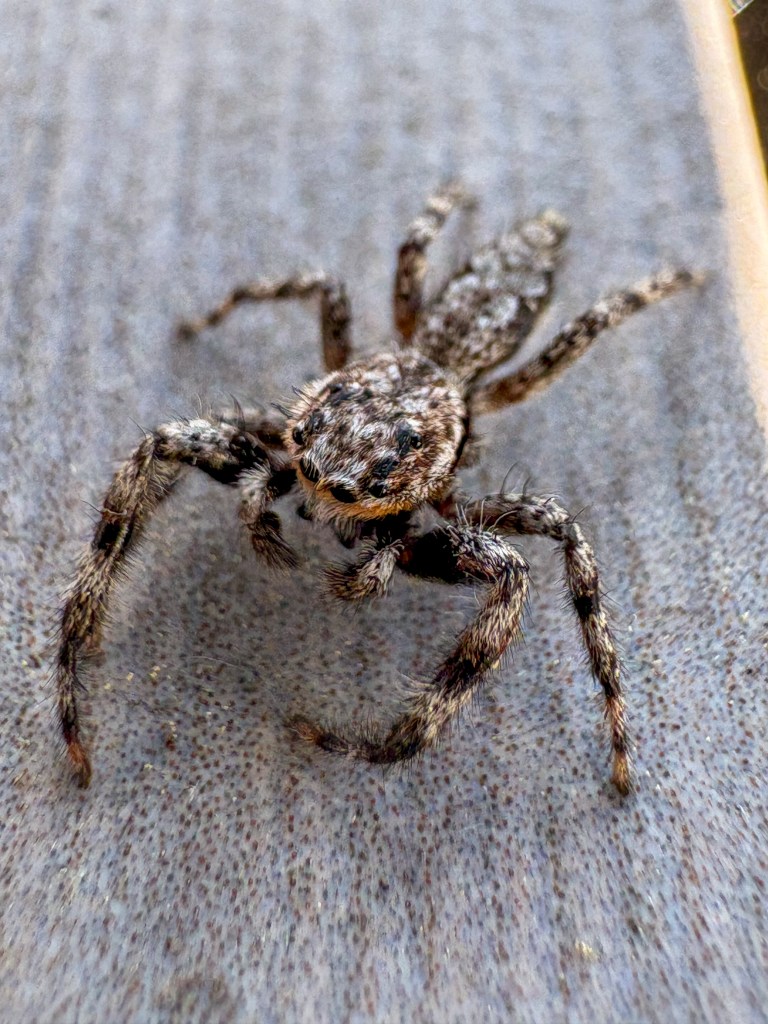
Fearless & Unfazed:
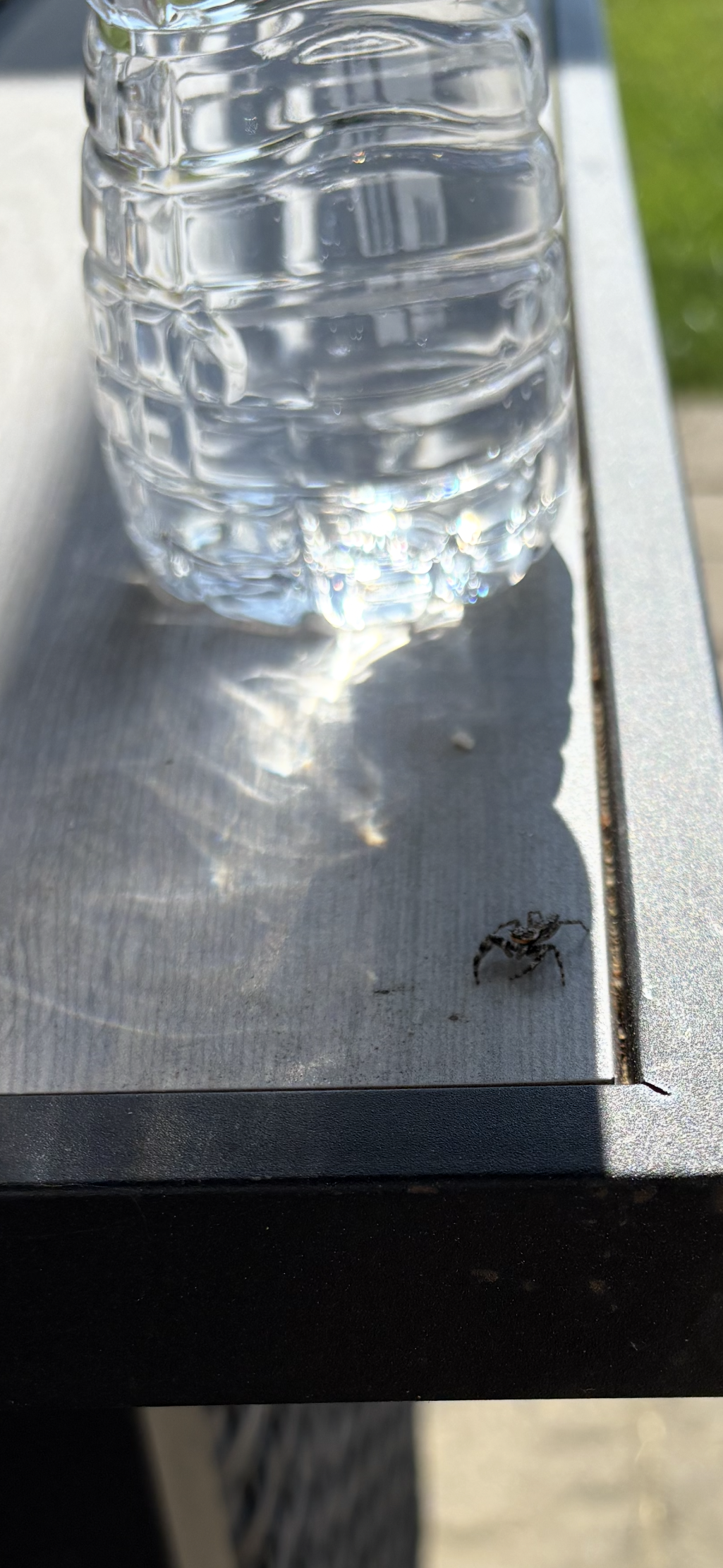
Sitting on the patio, enjoying a hot summer sun, I reached for my bottle of water and noticed this guy. This arachnid had crawled up to the edge of the table and sat there, watching me. When I put the bottle down he scurried over to it. He examined the massive standpipe and began to trek up the side. It appeared he enjoyed the translucency of the cooled walls and admired the distortion on the other side.
The bold spider surprised me even further. Clinging to the surface as I picked up the bottle again, he was not bewildered by me. In fact, I had to nudge him off with my finger, and even then I was met with his resistance.
It’s fascinating that a tiny creature like this jumping spider lacks any fear from a monstrous animal like a human. Arachnophobia hinders many of us from realizing that spiders like this actually enjoys coexisting with us.
Jumping spiders are known for their natural curiosity, especially towards humans. When they are not living on a sunny plant, they co-inhabit our spaces. Living on vertical spaces, like walls and ceilings, they use artificial light to help them hunt. Although they do not spin webs, they will use silk to help with molting, laying eggs and taking a rest.
Super Powers
These diurnal hunters have otherworldly athletic abilities that often get overlooked because of their size. Jumping spiders can leap anywhere from ten to fifty times their own body length, a feat that would only make sense coming from a comic book hero. And while this distance is impressive, how they jump is just as compelling.
Like a well-oiled machine, these spiders possess a built in hydraulic system in their legs. The spider rapidly increases its blood pressure in the legs, then extends and flings itself through the sky. Leaping such grand distances requires accuracy and highly-tuned depth perception, which is supplemented by their impeccable vision. Lastly, to remain in control of these extreme stunts, they will use a silk line to stabilize themselves, just in case they miscalculate. But even in crash landing scenarios, the spiders’ exoskeletons prevents any harm.
As mentioned before, these spiders are diurnal hunters, meaning they go about this activity during the day time. Using its massive leap, it will intercept prey and subdue it with a venomous bite. The prey, consisting of various small insects, has no chance of hiding due to the spiders’ near 360 degree vision. Whether you’re a meal worm crawling on the ground of a fly zooming through the air, you are in jeopardy of becoming a jumping spiders next victim.
Super Heroes Need Love Too
Life is not just about food. When looking for a mate, male jumping spiders attract the ladies through a series of dances and vibrations. After a pair is formed the female might decide that her judgment was off and ends up attacking or resisting the sperm transfer. Even after the male transfers sperm, the female can store it and take another males sperm. This is to decide at a later date which sperm she would like to use.
Like many arachnids, jumping spiders will molt their skin about 5-9 times throughout their life, eventually stopping when fully grown.
It’s safe to say these creatures would be an apex predator if they weren’t nerfed in size. From leaping great distances in a single bound to a hulk-like durability; the super-powers of Platycryptus undatus are a marvel to behold.
 Our Backyard Universe
Leave a comment